Commentary: Singaporean companies are not spared the impact of Myanmar’s political woes
SINGAPORE: Singaporean businesses, like other enterprises in Myanmar, accept been trying to navigate the turbulent waves created by the armed forces coup on Feb 1.
Their operations have been affected in three main ways: Everyday disruptions brought nearly by political protests against the coup, challenges raised past the measures taken past the military government to assert control over resistance to the coup, and greater scrutiny of Singaporean businesses and their links with the Myanmar military machine.
In the first few days later the coup, net blackouts and communication blocks gear up by the military government created communication challenges betwixt Singapore headquarters and their in-country staff.
The armed forces regime has since ordered several temporary internet shutdowns.
READ: Commentary: As Myanmar insurrection persists, indigenous armed groups come up under greater pressure to act
At present, access to the internet is heavily blocked — it is shut down between 1 am and 9 am, and mobile internet and pocket Wi-Fi have been cut. Only broadband Wi-Fi is working.
Besides restricting communication, this has made it difficult for news and data to be disseminated, an invaluable resources at a fourth dimension of uncertainty and rapid change.
DISRUPTIONS FOR COMPANIES
In February, the military regime adopted a 2022 Electronic Transactions Law Amendment that increases the criminalization of data use and sharing, and creates problematic data protection rules.
These changes came a few days after a typhoon Cyber Security bill was proposed by the armed services authorities to give it the power to cake websites, society internet shutdowns, and restrict the broadcasting of what it considers fake news.

In add-on, Singaporean businesses are in facing disruptions in workflow and cashflow. Many shops, factories and banks take been closed due to the political protests.
At the same time, the participation of ceremonious servants in the civil disobedience movement has slowed down the processing of permits, licences and other bureaucratic procedures.
Banks remain airtight due to political protests on the part of banking company employees. Equally a upshot, carrying out fiscal transactions has become a challenge for all businesses in Myanmar.
Businesses and individuals akin are unable to employ over-the-counter services such as cyberbanking in or cashing cheques and withdrawing or transferring large amounts of money.
Although information technology is still possible to withdraw cash from ATMs and transfer money online, the limits on these amounts make it challenging to pay for higher value items such equally hire, supplies, starting time-up costs and so on.
INTENSE SCRUTINY
To compound matters, Singaporean businesses accept come up under increased scrutiny by international and Myanmar activists.
As Singapore has been the largest strange investor in Myanmar since 2012, having invested more than US$24 billion (Southward$32.2 billion) between 1988 and January 2021, activists are calling on the public to pressure Singapore companies to cut ties with the Myanmar armed forces and its associated businesses and then equally to undermine the authorities's political legitimacy.
READ: Commentary: Thailand as a model? Why Myanmar armed services may follow Prayuth'southward example
READ: Commentary: China'south boycott of H&Grand, Nike and other big brands is really baroque
In Myanmar, the nature of links between businesses and the military is wide-ranging in scope. They include, among other things, the leasing of land, the sale and purchase of appurtenances and services, joint ventures, and stakes in the two military conglomerates, Myanmar Economic Holdings Express (MEHL) and Myanmar Economic Corporation (MEC) and their subsidiaries.
These conglomerates, owned and influenced by senior armed services leaders including Commander-in-Main Senior General Min Aung Hlaing, ain more 100 businesses beyond many sectors of the economy, including manufacturing, construction, precious stone extraction, tourism and banking.
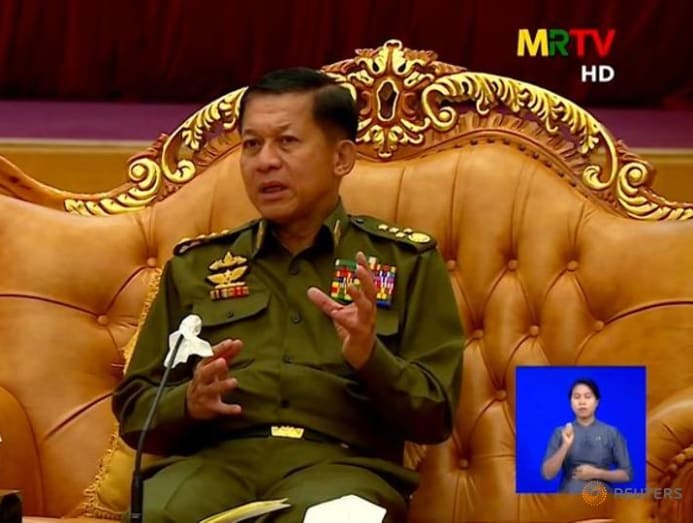
The revenue from these businesses strengthens the war machine'southward autonomy from old elected civilian oversight and provides financial support for its operations.
Amidst those Singaporean companies that have been singled out is Emerging Towns and Cities (ETC). Golden City, the company's residential and commercial project was to be built on state reportedly leased from the war machine.
ETC suspended trading of its shares on the Singapore Commutation after the latter launched an official query. It has as well reportedly engaged an independent professional to review some of its dealings in Myanmar.
READ: Commentary: Myanmar learnt the wrong lessons from Indonesia's political transition
TRD, which supplies anti-drone guns, has reportedly stopped doing business organization in Myanmar after it became known that the Myanmar law were using these devices against protestors. It has also been reported that Coda, a Singapore-headquartered digital payments company, has removed military-affiliated telecoms firm Mytel from its portfolio.
DIVESTMENT THE WAY Frontwards?
Razer's co-founder and manager declared that he would sell his one-3rd stake in a joint venture that owns RMH Singapore, which in plow owns 49 per cent of Myanmar'due south cigarette maker Virginia Tobacco Company. The rest of Virginia Tobacco is owned by MEHL.
It is likely that other Singaporean businesses will divest their holdings to cut their links with the military'southward conglomerates and or to seek profits in other countries in the region. Surprisingly though, the Singapore Concern Federation (SBF) has received enquiries from Singapore enterprises that are keen to explore future business opportunities in Myanmar.

Despite the turmoil and upheaval of the insurrection, it appears that Singaporean businesses are determined to ride out the storm.
Co-ordinate to the SBF, many Singaporean enterprises in Myanmar are keenly enlightened of the risks and challenges of operating in an emerging economy. They have been mentally prepared for political upheaval.
Those Singaporean businesses that remain in Myanmar are keeping their heads downwardly and paddling hard to keep adrift. Their goal is to reap long-term gains and their ability to survive will depend on their tenacity, adaptability and ties with their Myanmar community.
Dr Su-Ann Oh is a Visiting Fellow of the Myanmar Studies Plan at ISEAS – Yusof Ishak Plant. This article was first published by ISEAS – Yusof Ishak Institute as a commentary in Fulcrum.
Source: https://cnalifestyle.channelnewsasia.com/commentary/commentary-singaporean-companies-are-not-spared-impact-myanmars-political-woes-298181
0 Response to "Commentary: Singaporean companies are not spared the impact of Myanmar’s political woes"
Post a Comment