How Many Cups Is 1 Pound of Ground Beef Calculator Soup
How To Summate Recipe Cost
The recipe cost breakdowns are a big part of Budget Bytes. And while you're not probable to take the exact same food costs equally me (prices vary quite a bit from location to location, day to twenty-four hour period, and fifty-fifty store to store), I call up information technology's helpful to see how each ingredient tin can impact the overall cost of a recipe. So now I'd like to dive a piddling deeper to show y'all how I brand these calculations, and teach you how to calculate recipe costs yourself. Because even if yous do it one time, I promise yous'll learn a lot!
Originally posted 6-thirty-2013, updated 5-21-2020.
Why Calculate Recipe Costs?
My large "Ah-ha!" moment came when I calculated the toll of my first few recipes. I was always very mindful of the total corporeality I spent at the grocery store every calendar week, merely seeing the breakdown of each ingredient and the total recipe cost that truly revolutionized my fashion of cooking.
Seeing this breakdown helped me acquire how to tweak recipes to make them more filling for less money, while maintaining maximum flavour. I learned that scaling dorsum but a little on the most expensive ingredients (nuts, cheese, meat, etc.) dramatically reduced recipe costs, but didn't have a huge impact on flavor. As well, I learned which inexpensive ingredients helped give my food a big flavor kick for pennies (light-green onions, cilantro, freshly croaky pepper, dried herbs, etc.), and which ingredients I could use to bulk up a recipe without profoundly increasing the total cost (rice, pasta, beans, lentils, cabbage, carrots, potatoes, etc.).
What Method Exercise You Use?
Hither on Upkeep Bytes I utilise the same method of calculating recipe costs used by commercial food service operations—adding the costs of each ingredient used, in the amount used, rather than adding the full price of items purchased. Some argue that you can't only purchase 2 Tbsp of olive oil, so the recipe actually costs more to make. The counter argument to that is that you don't purchase an unabridged canteen of olive oil every time you make a recipe, nor practice I consider an ingredient "free" if I already accept it in my kitchen and didn't need to purchase it for that recipe. Both methods take their caveats, simply I find the method used here to exist the most representative of the recipe'south truthful cost.
What Do I Demand to Calculate the Toll of a Recipe?
The process is elementary and doesn't crave a lot of time or "equipment." Information technology's so elementary, in fact, that I do this, by hand, forevery single recipe on this website (well over 1000 recipe at this betoken). To calculate recipe costs you'll demand:
- Your receipts
- Original ingredient packages
- Pen and paper
- Computer
- Grocery shop website (as a backup for sourcing prices)
How To Calculate Recipe Costs – Pace past Step Tutorial
Okay, so permit'due south walk through, step by step, what I practice to calculate the cost of a recipe on Budget Bytes. For this tutorial, we'll be using the Flossy Tomato plant and Spinach Pasta recipe equally an example.
Step 1: Write down the recipe ingredients and quantities
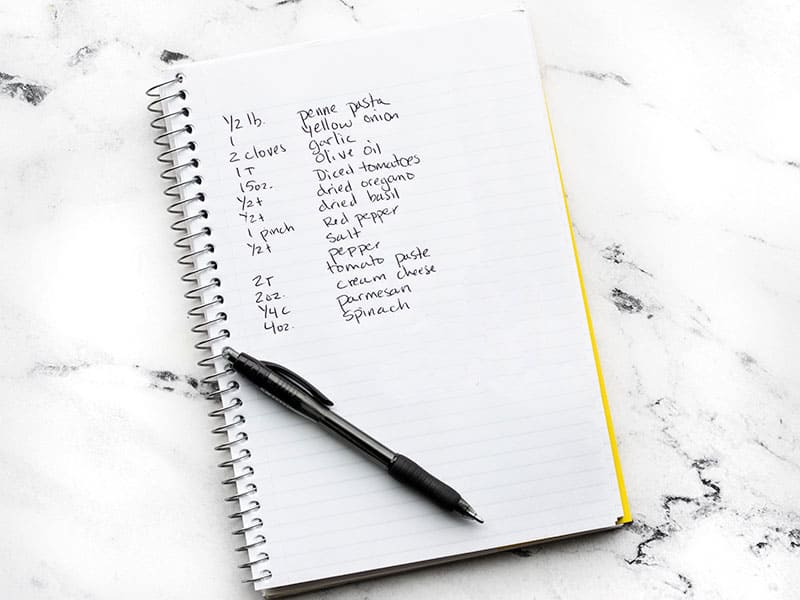
If you like to print your recipes, you can do the calculations right on the printed version of the recipe. I e'er practise my calculations in my recipe development notebook. You lot'll fill out the prices in the right hand column every bit y'all practice the calculations.
Step ii: Fill in prices for ingredients that were used "whole".
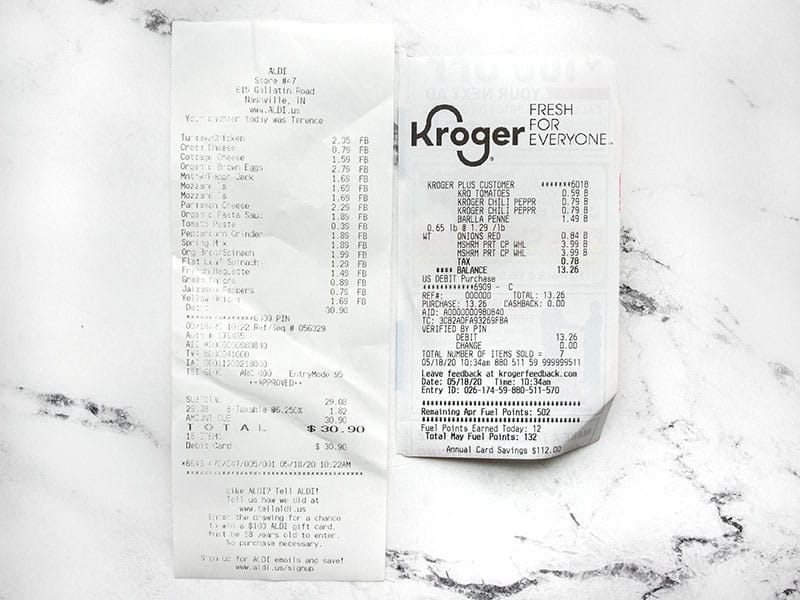
Get together your receipts and record the prices for any ingredient that y'all used in the "whole" class. This could exist ingredients similar a can of tomatoes, a cucumber, mayhap a jar of pasta sauce, a unmarried bell pepper, etc. In this Creamy Tomato and Spinach Pasta at that place was only ane ingredient that I used in the total volume purchased—diced tomatoes. Yous can see this particular listed as "kro tomatoes $0.59" on the Kroger receipt. Record the price next to this item on your recipe ingredient list.
Note: If you don't take your receipts, check your grocery store's website. Some larger stores, like Kroger, allow you to look up items online and the price volition be displayed.
Stride 3: Calculate Majority Produce Items
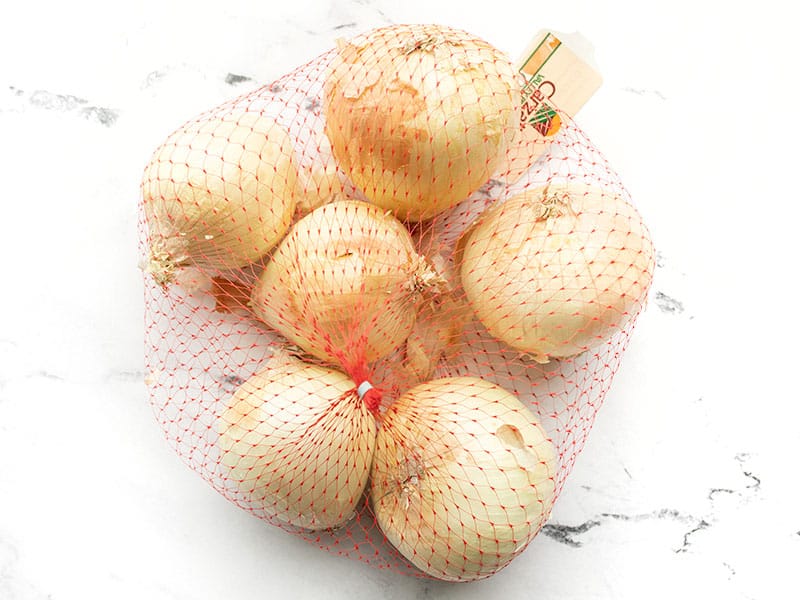
For bulk produce items, take the total cost listed on the receipt and carve up past the number of items purchase. The total price for this bag of yellow onions listed on the receipt was $1.69 and at that place are half dozen onions in the bag, so each onion is approximately $0.28. Record this cost on your recipe ingredient list.
This method works good for other bagged produce, similar apples, carrots, oranges, lemons, potatoes, etc. and too things similar packages of chicken thighs or breasts.
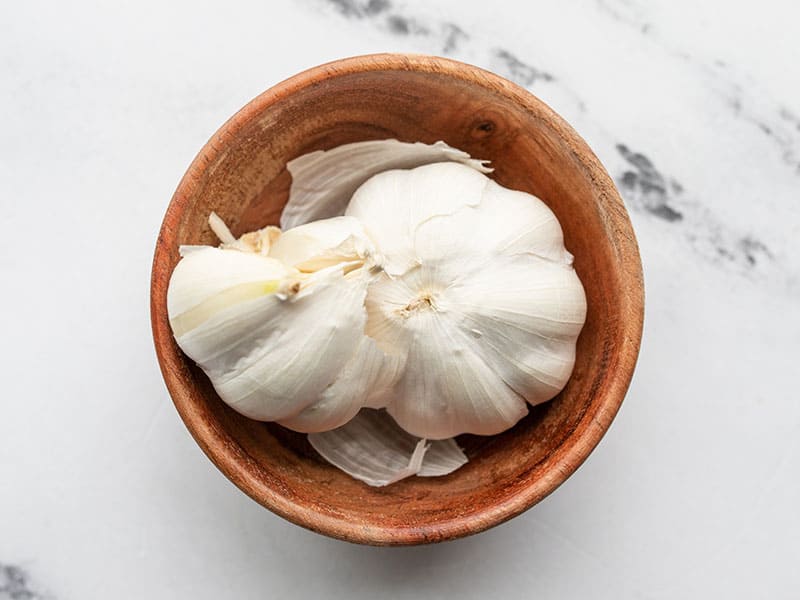
For garlic, each head is unremarkably around $0.60-$0.65 and I get on average about 8 adept sized cloves from each caput, so I just estimate nigh $0.08 per clove.
Stride 4: Utilise Packet Labels to Calculate Fractional Ingredient Costs
For most ingredients you'll need to use the information listed on the ingredient packages to determine the cost of the amount used in the recipe. Hither are some examples:
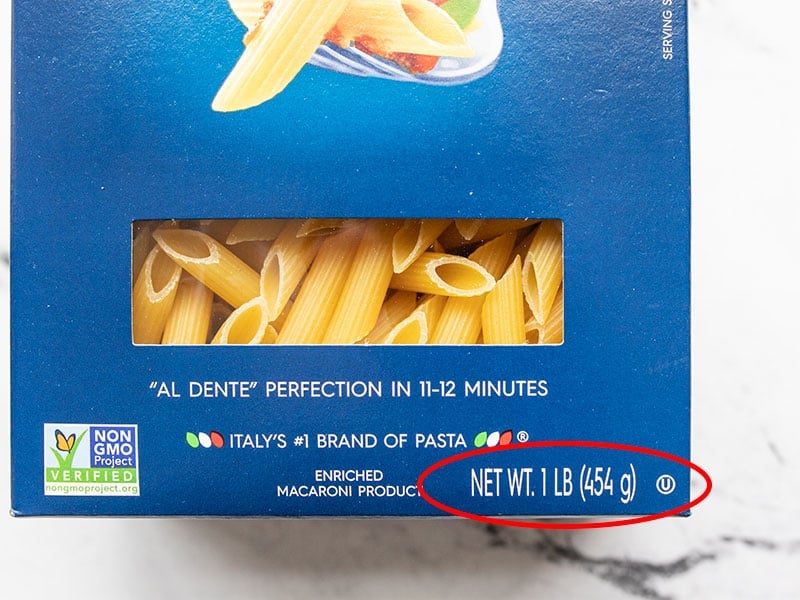
This recipe used one/2 lb. of penne pasta. The whole box (1 lb.) cost $1.49. Since I used half the box, the price of the amount used is $1.49 ÷ ii = $0.75.
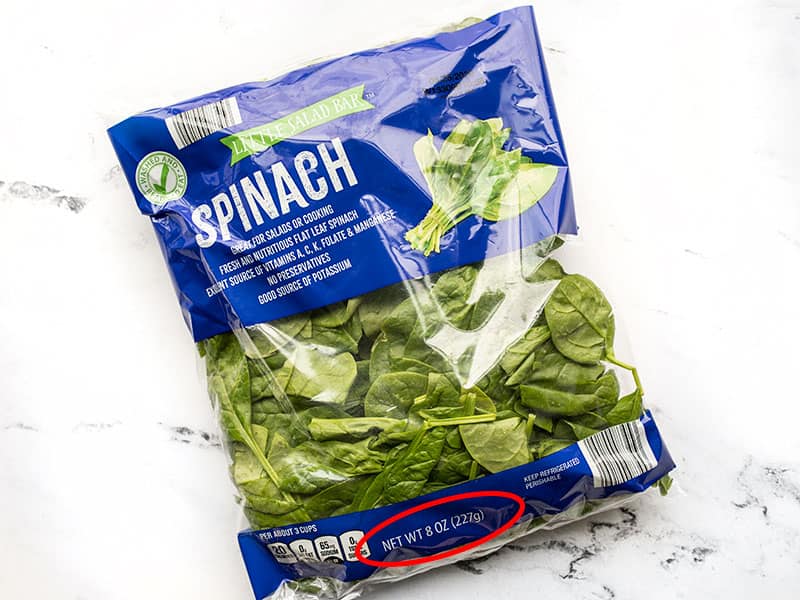
The same method was used for this bag of spinach. The full 8 oz. bag cost $one.29, so the cost of the 4 oz. used is $1.29 ÷ two = $0.65.
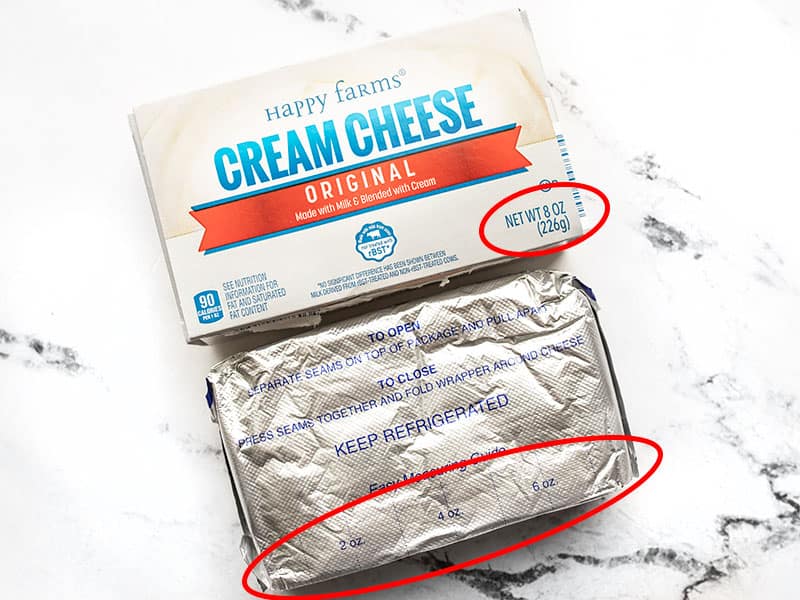
Sometimes the manufacturers are squeamish and provide helpful guides for measuring. This full 8 oz. parcel of foam cheese cost $0.79, so the cost of the ii oz. used in the recipe is $0.79 ÷ four = $0.20.
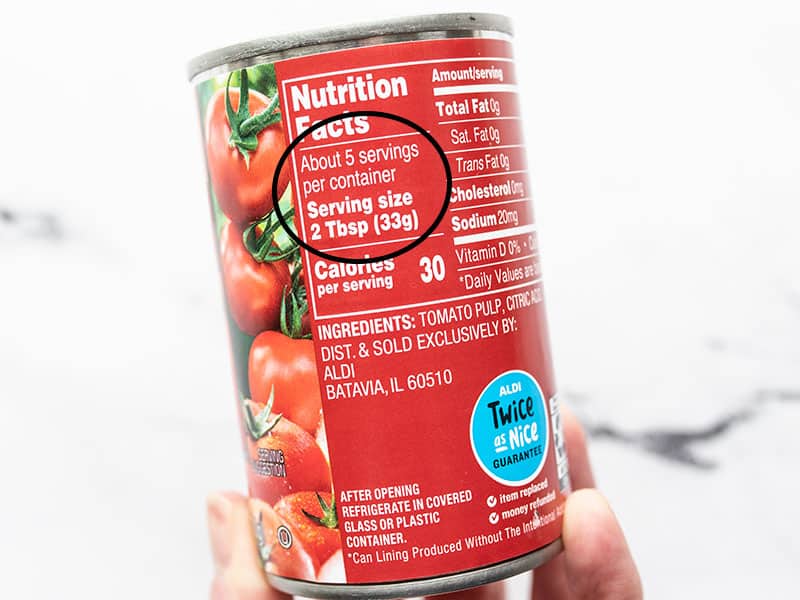
Sometimes the calculations can get a little more involved. The price of this 6 oz. tin can of tomato plant paste was $0.39. We tin can see on the diet label that in that location are 5 servings of 2 Tbsp in the can, or a total of 10 Tbsp per tin can. We used 2 Tbsp for the recipe, so the toll of what we used is $0.39 ÷ 5 = $0.08.
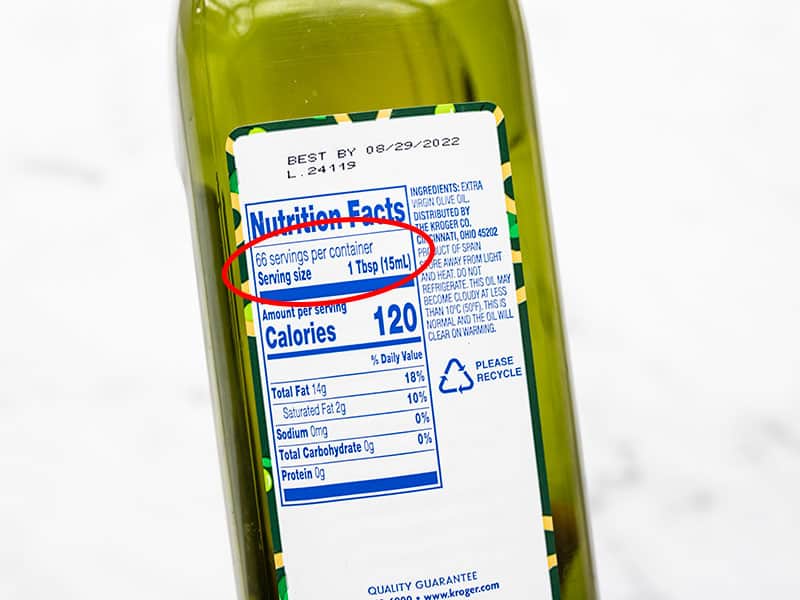
I bought this bottle of olive oil a while back, then I had to refer to Kroger.com to get the cost. The full price for this canteen was $5.95. We tin can see on the nutrition label that in that location are 66 servings of 1 Tbsp in the whole bottle. Nosotros used 1 Tbsp for the recipe, so the price of what we used is $five.95 ÷ 66 = $0.09.
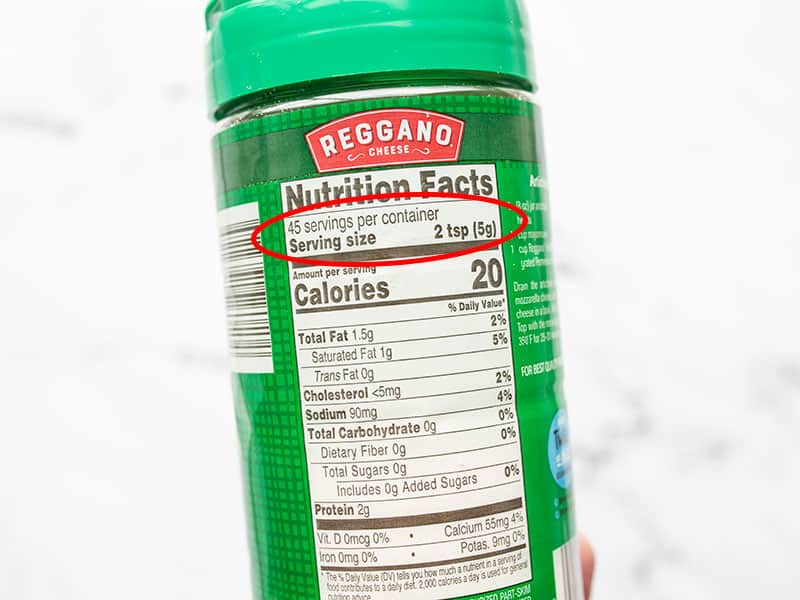
This Parmesan cheese is about as complicated as the calculations ordinarily get because we're converting between unit types. We see on the characterization that there are 45 servings of 2 tsp in the whole canteen. We used 1/four cup in the recipe. Then first I calculated the price per tsp: $2.29 (total canteen price) ÷ 45 ÷ 2 = $0.025 per tsp. I know there are 3 tsp per tablespoon, and four tablespoons per 1/4 cup, then I calculated a footling further: $0.025 ten iii ten 4 = $0.31 per ¼ loving cup.
Footstep 5: Estimate Costs for Herbs and Spices
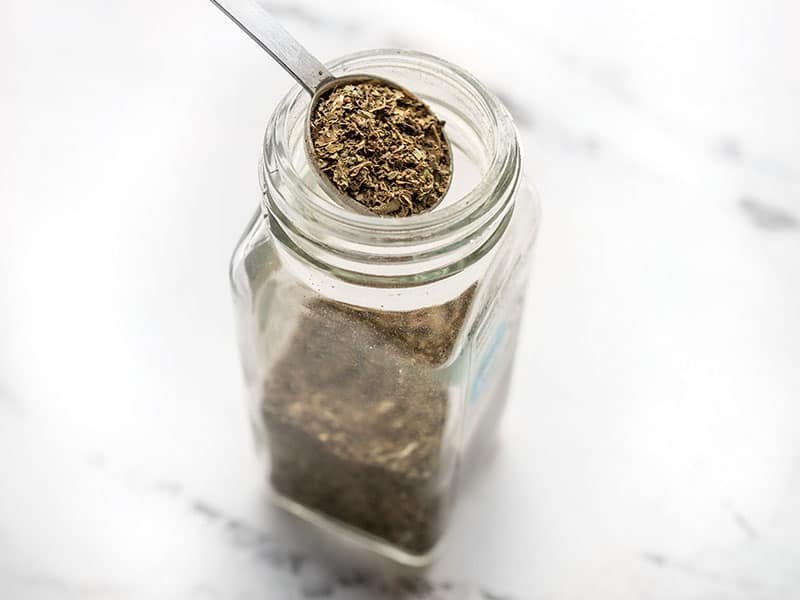
Herbs and spices don't have diet labels with serving sizes to work with, and often the unabridged container but weighs less than 2 oz. Unfortunately I don't have a kitchen scale that is sensitive plenty to counterbalance something equally low-cal equally a i/2 tsp of a dry out herb. So, for my purposes I use a generic (and generous) allotment of $0.ten per tsp for near dried herbs and spices. For table salt and pepper I estimate a niggling less and for whatsoever rare herbs or spices I double the generic estimation. Then, for this recipe: 1/two tsp dried basil = $0.05, one/2 tsp dried oregano = $0.05, 1 pinch crushed cherry pepper = $0.02, 1/2 tsp salt = $0.02, freshly croaky pepper = $0.03
Step 4: Add it all together!
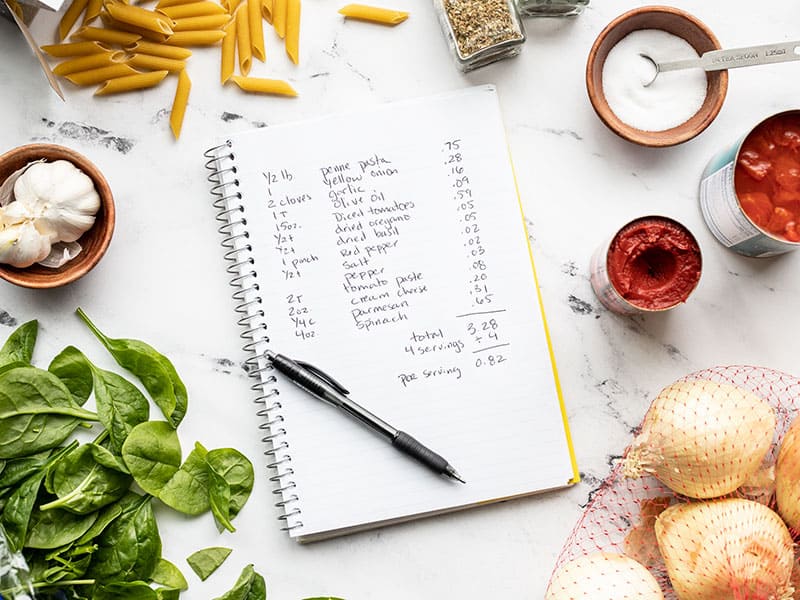
Then finally, we have all of the prices of the ingredients filled in on the recipe ingredient listing. Now simply simply add them all together and and then separate by the number of servings and you've got the price per serving. So for this recipe, the full cost was $3.28 and with four servings that'southward $3.28 ÷ 4 = $0.82 per serving.
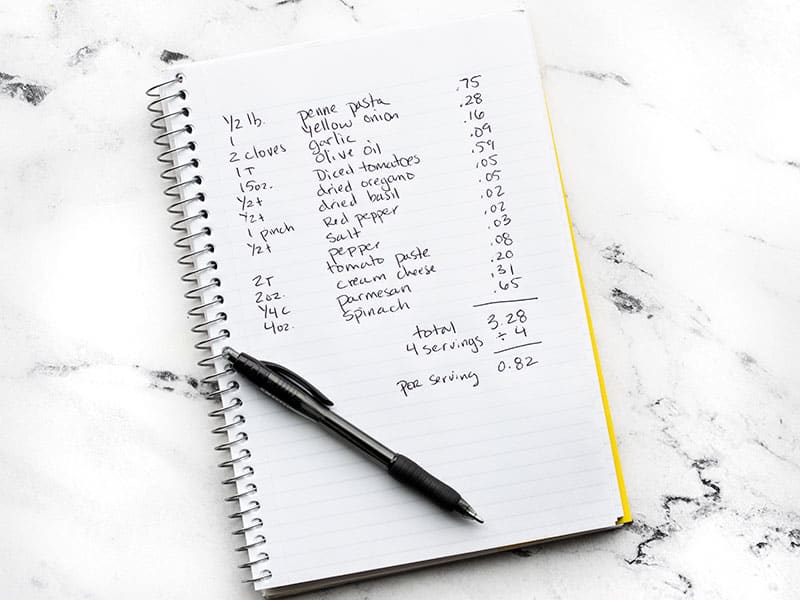
Every bit you can meet, it'south not an verbal scientific discipline, but it will definitely shed some lite on where your money is really going. I hope you attempt it out at least once just to see how it goes. If you want to practice it on a regular basis, y'all can outset a spreadsheet with price per unit information for your pantry staples. This way you'll accept a record of the cost for items that you may simply buy a few times per year (and probably won't take the receipt handy). Luckily, my blog acts as a "tape" of these prices, and so I tin quickly refer back to my final buy price.
What About Electricity, Gas, and H2o?
Every now and then I get a question about how utilities add to my recipe costs. Unfortunately I don't have a manner to measure out the amount and cost of the most of the utilities used in the recipes, but I'm confident that it would be a very small-scale amount. For instance, in this recipe I used one/2 cup water in the sauce. After checking my last water bill, I paid $0.003 per gallon of h2o. I round to the nearest cent for these calculations, so the cost of the 1/two cup water in this recipe is negligible. Water is piece of cake to measure, only I don't think I could measure the amount of gas or electricity used to heat the oven.
Handy Conversions for Calculating:
- 3 tsp = one Tbsp
- 4 Tbsp = 1/iv cup
- 2 Tbsp = 1 fluid ounce
- 16 Tbsp = one loving cup
- two fluid ounces = ane/4 cup
- 8 fluid ounces = 1 cup
- 16 weight ounces = 1 pound
Note: "fluid ounces" are a volume unit, weight ounces are a measurement of mass. Solid ingredients are usually listed as weight ounces, liquid ingredients are usually listed in fluid ounces. 8 fluid ounces of one ingredient may not equal 8 weight ounces of that aforementioned ingredient. That will depend on the private density of the ingredient. Cheese is a great example. iv oz. (weight) of cheese is equal to about i cup (volume) of shredded cheese. I cup is eight fluid ounces in volume, but only 4 weight ounces of shredded cheese.
Try Information technology Yourself!
I promise I didn't scare you off with all these calculations! It really is quite uncomplicated, particularly after y'all practise it a few times. If you're interested in giving it a shot, get-go with a uncomplicated recipe that only has 3-5 ingredients and see how you do! Then, let me know how it worked out in the comments below. :)
P.South. Did you know you can browse our recipes past Cost per Recipe and Cost per Serving?
Source: https://www.budgetbytes.com/how-to-calculate-recipe-costs/
0 Response to "How Many Cups Is 1 Pound of Ground Beef Calculator Soup"
Post a Comment